
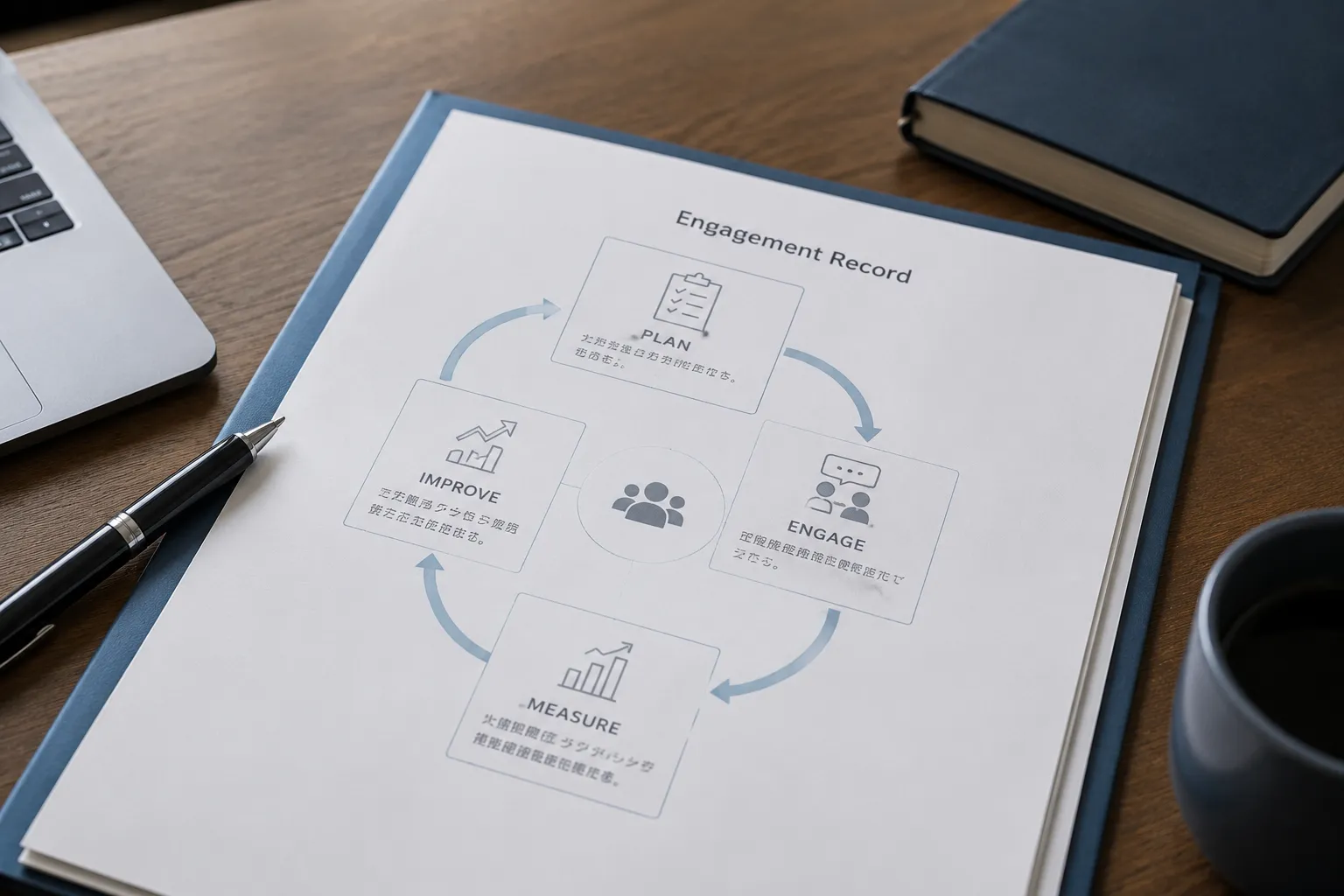
Preparing for a one-on-one meeting with an institutional investor is not about memorizing performance figures. It means being able to speak, in your own words as a manager, with a consistent line across three themes: cost of capital, capital allocation policy, and corporate governance. A lack of consistency across these three is the single most common reason a meeting leaves a poor impression.
What Questions Come Up Most in Institutional Investor Meetings?
According to "Corporate Interviews (Summary of Results) – Engagement by Institutional Investors: Companies' Evaluations and Challenges," published in April 2025 by Japan's Government Pension Investment Fund (GPIF), the topics investors raise in dialogue extend well beyond a review of financial and business results, into sustainability, governance, cost of capital, and the quality of disclosure (GPIF, "Corporate Interviews (Summary of Results)," published April 2025, URL: https://www.gpif.go.jp/esg-stw/interview_202504.pdf). The same report notes that investor questions have grown more specific than before, citing business portfolio management, succession planning, board governance, skills matrices, supply chain management, and human rights due diligence as recurring topics. At the same time, companies also reported that short-term performance questions remain common — so a strong set of anticipated Q&A needs to cover both medium- to long-term management policy and near-term results.
What Are the Three Themes to Prepare?
Preparation should be built around three pillars: cost of capital, capital allocation policy, and corporate governance.
Cost of capital — The GPIF report describes cases where investors discuss with companies the level and calculation method of cost of capital, the breakdown of price-to-book (P/B) drivers, and the need for profitability management by business segment. On ROIC (return on invested capital), several investors quoted in the report emphasize how the figure is used for segment-level profitability management and by leadership, more than the number itself. The Securities Analysts Association of Japan's "Cost of Capital Survey" (conducted March 10–24, 2020; sent to 24,776 CMA — Chartered Member Analysts of the Association; 750 responses, a 3.03% response rate) is built around 11 questions covering how frequently and for what purpose companies use cost of capital, how they gauge its level, and how they estimate cost of equity under CAPM, including how the risk-free rate and equity risk premium are set (Securities Analysts Association of Japan, "Cost of Capital Survey," URL: https://www.saa.or.jp/standards/disclosure/capitalcost1/index.html). Even among analysts, approaches are not uniform, so companies are expected to be able to explain their own calculation assumptions clearly.
Capital allocation policy — The GPIF report describes discussions that go beyond simple shareholder returns, covering the sale of cross-shareholdings (shares held for strategic or business-relationship purposes) and fixed assets, share buybacks, R&D investment, and the setting and disclosure of DOE (dividend on equity ratio) or a revised payout ratio. Rather than simply strengthening shareholder returns, companies are often asked to explain how they balance returns against growth investment.
Corporate governance — Investor interest, as described in the report, centers on board size, composition, and director terms, the proportion of independent outside directors, and disclosure of the skills matrix. Direct dialogue between outside directors themselves and investors is also said to have expanded rapidly in recent years.
Which Questions Should the CEO Answer Personally — and Which Can IR Handle?
The GPIF report includes company comments describing the CEO as the central figure in dialogue with investors on cost-of-capital- and share-price-conscious management, alongside investor comments expecting CEO meetings to go deep on medium- to long-term vision. Confirming short-term results and financial figures, by contrast, tends to fall to the IR team as the point of contact. Going into a meeting without first sorting out this division of roles risks the CEO and IR team giving conflicting answers on the same point — and that inconsistency is exactly what damages the evaluation of the meeting. As a rule of thumb, it tends to work well in practice for the CEO to speak to the underlying rationale for capital allocation and governance and the thinking behind management decisions, while IR handles the details and background of figures already disclosed.
How Far in Advance Should Disclosure Materials Be Prepared?
The GPIF report describes companies that proactively publish, as IR materials, answers to questions investors frequently ask, as well as one case where a company shows investors footage of board meetings as part of assessing board effectiveness. Some companies are said to run a cycle that starts from the integrated report and feeds investor questions and comments back into the following year's disclosure. On the other hand, the report also notes cases where ESG meetings proceeded without advance questions from investors, leaving the company feeling underprepared. When building your anticipated Q&A, it is advisable to come to the meeting with materials already prepared on the three themes — cost of capital, capital allocation policy, and corporate governance — regardless of whether questions have been submitted in advance.
What Recurring Patterns Emerge From Investors' Publicly Stated Interests?
GPIF's "Corporate Interviews (Summary of Results)" compiles interviews that GPIF staff conducted, in person or online, between April and December 2024, with 33 listed companies that had cooperated in a survey on institutional investors' stewardship activities. The report is organized into eight sections, from I. General through VIII. Other (equity and bond investors); among these, the sections on cost-of-capital- and share-price-conscious management, dialogue between outside directors and investors, and the exercise of voting rights contain the most concrete company-side evaluations and challenges related to capital allocation policy and corporate governance. The Securities Analysts Association of Japan's "Cost of Capital Survey" is a summary of results from 11 questions on how companies actually use cost of capital, covering how they gauge its level, how they set CAPM parameters, and their initiatives to raise corporate value.
Neither source is a ranking or database of question frequency; both simply describe the themes investors and analysts say they care about. In practice, it makes sense to build your anticipated Q&A around the areas of interest these two sources point to — the basis for calculating cost of capital, the thinking behind capital allocation policy, and the effectiveness of governance — and then map your own company's specific business situation onto them.
How Should Follow-Up After the Meeting Be Handled?
The GPIF report describes companies that share the results of investor meetings with the CEO and others twice a year and feed them back to the board for discussion. Some companies are said to organize ESG-related comments by E, S, and G category to make points raised by multiple investors visible. One case in the report also links investor feedback directly to the announcement of a growth strategy, including a strategy in an area where the company had lagged relative to peers. After a meeting, it is worth having a standard process: share any questions you could not answer internally, feed them back through management and the board, and reflect them in the next round of dialogue and in improved disclosure.
FAQ
Q1. For an institutional investor meeting, should the CFO or the CEO attend?
In practice, the answer depends on the topic. The GPIF report includes company comments describing the CEO as the central figure for direct dialogue with investors on cost-of-capital- and share-price-conscious management, alongside investor comments expecting CEO meetings to go deep on medium- to long-term vision. A division of labor in which the CFO and IR team handle detailed confirmation of financial figures, while the CEO speaks to the underlying rationale for capital allocation, governance, and medium- to long-term strategy, tends to keep answers consistent.
Q2. If a question can't be answered during the meeting, should you follow up later?
As a general matter, following up later with a clear timeline is generally understood to preserve trust with investors better than leaving a question unanswered. The GPIF report also describes companies that feed meeting results back to management and the board and reflect them in future dialogue and disclosure — suggesting that the act of sharing unanswered items internally and following through is itself viewed favorably by investors.
Q3. How often should institutional investor meetings be held?
No single standard is given, but the GPIF report cites examples of sustainability discussions being requested separately from quarterly IR meetings, and of meetings with senior executives held once every six months. Many companies appear to work out, in line with their own disclosure cycle, who they meet with and how often — quarterly, semi-annually, or annually.
Summary
| Preparation Theme | Key Points to Cover |
|---|---|
| Cost of capital | Level and calculation method, breakdown of P/B drivers, how ROIC is used |
| Capital allocation policy | Sale of cross-shareholdings and fixed assets, share buybacks, R&D investment, thinking on DOE and payout ratio |
| Corporate governance | Board composition, terms, and skills matrix; dialogue between outside directors and investors |
| Division of roles in answering | CEO for underlying policy; IR for detailed figures |
| Post-meeting follow-up | Organize unanswered items; share with management and the board; reflect in the next dialogue |
Sources: GPIF, "Corporate Interviews (Summary of Results)" (published April 2025), URL: https://www.gpif.go.jp/esg-stw/interview_202504.pdf; Securities Analysts Association of Japan, "Cost of Capital Survey" (conducted March 2020), URL: https://www.saa.or.jp/standards/disclosure/capitalcost1/index.html
For a confidential initial consultation (free of charge), contact us through our enquiry form.
※ This article organizes general points and is not advice on any specific matter. Specific consultations are handled on a confidential basis.